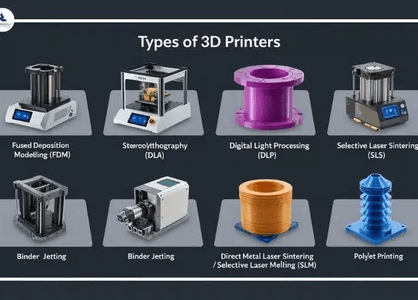
3D printing has become an important manufacturing technology across many industries. It enables the creation of complex geometries with a high degree of precision and minimal waste. The most common vat photopolymerization techniques are stereolithography (SLA) and digital light processing (DLP). But both depend on layer-by-layer fabrication. This reduces the printing speed and generates separation forces between the cured layer and the resin vat. These restrictions prevent their use in mass production.
To overcome these limitations, Hindered Asynchronous Light Synthesis (HALS), a new proprietary vat photopolymerization technology, was developed. This article discusses the working principle of HALS 3D printing, its advantages over conventional methods, and its potential for industrial production.
What is HALS 3D Printing?
HALS is a resin-based 3D printing process that uses light to cure a liquid photopolymer, and it doesn't involve the stop-and-peel routine of older systems. It builds parts through two coordinated mechanisms, each captured in its name.
The Hindered Mechanism
At the bottom of the resin vat, there is a transparent window. Just above it, HALS maintains a thin layer rich in oxygen or a similar inhibiting agent. Light still enters this zone, but the chemical reaction that hardens the resin is deliberately held back here. In this narrow band, the resin remains liquid even under UV exposure.
This “dead zone” does a couple of important things: it means the printed part never hits the window. Fresh resin flows continuously into the space where curing actually happens, right above the dead zone.
The Asynchronous Mechanism
Nothing sticks to the window, so the build platform doesn't have to stop and lift up. Rather, it rises in a smooth motion. The AI system modifies the intensity and timing of the light on the fly, responding to the speed of the platform, the behavior of the resin, and the shape being formed at that moment. The exposure is not set frame by frame but constantly changes to suit the needs of the part.
Process Workflow of HALS
Here is the workflow of HALS 3D printing:
1. Model Design
The process starts with a three-dimensional (3D) model using computer-aided design (CAD) software or a 3D scanner. The digital model describes the geometry of the final component.
2. File Preparation
The model is imported into the slicing software and converted into machine-readable instructions. At this point, printing parameters are defined, including exposure settings and build orientation.
3. Resin Preparation
Resin is poured into the resin vat, and the build platform is positioned at the initial printing height to begin fabrication.
4. Continuous Printing
Ultraviolet (UV) light selectively cures the liquid resin according to the digital model. The build platform moves continuously while fresh resin replenishes the curing region, enabling uninterrupted part formation.
5. Post-Processing
Once the print is complete, the part is removed from the build platform, washed to clear away any uncured resin, and then post-cured with UV light to achieve its final mechanical properties and dimensional stability.

Comparison: HALS vs. SLA vs. DLP vs. CLIP
Here is how HALS compares to SLA, DLP, and CLIP:
|
Feature |
SLA |
DLP |
CLIP |
HALS |
|
Light Source |
UV laser, traces point by point |
The projector exposes the full layer at once |
UV LED with oxygen-permeable window |
AI-controlled dynamic light field |
|
Curing Method |
Layer-by-layer |
Layer-by-layer |
Continuous, dead-zone based |
Continuous, dead-zone-based with AI timing |
|
Printing Speed |
Slow (10–20 mm/hr) |
Medium (20–40 mm/hr) |
Fast (100+ mm/hr) |
Very fast (200–500+ mm/hr) |
|
Peeling Required |
Yes |
Yes |
No |
No |
|
Mechanical Strength |
Anisotropic, weaker on the Z-axis |
Anisotropic |
Isotropic |
Isotropic |
|
Surface Finish |
Very smooth |
Slight pixelation |
Layerless |
Layerless |
|
Typical Use |
Fine detail, jewelry |
Dental models, figurines |
Midsoles, small parts |
Full parts, industrial-scale production |
Advantages of HALS 3D Printing
Speed at Scale
Because parts are pulled continuously rather than built layer by layer, HALS can generate components in minutes rather than hours, making it viable for volume manufacturing rather than one-off prototypes.
Stronger, More Consistent Parts
Without a peel step, the print doesn’t experience repeated mechanical stress. This gives isotropic strength so parts work uniformly in any direction, rather than breaking along weak layer lines.
Smoother Surfaces
HALS parts have no visible layer lines, so the finish is much closer to injection-molded products and often doesn’t require as much post-processing.
Design Freedom
Fine lattices and other complex geometries can be printed as a single piece, something that is difficult to do reliably with conventional layer-based methods.
Applications of HALS
Footwear
The most developed use case for HALS is still footwear, as one shoe contains a number of components that previously had to be manufactured separately.
- Midsoles and outsoles: Instead of traditional foam, fine lattice structures with zonal cushioning are used, in which the sole flexes differently at the heel, arch, and forefoot.
- Uppers: Some designs print the upper and sole as one continuous piece. No panels stitched together, no seams glued.
- Ventilated structures: Open lattice patterns are built directly into the sole as airflow channels.
- Everyday wear: The same logic applies to slippers, sandals, and casual shoes, where quick-drying, water-resistant materials are more important than athletic performance.

Robotics and Industrial Components
HALS is used to make soft robotic grippers, flexible joints, and hydraulic components with internal flow channels that need to be able to hold pressure without leaking and meet the standards usually associated with injection-molded parts.
Medical and Dental Devices
The material library provides a variety of materials, from flexible to rigid, and supports custom-fit devices such as orthotics, dental models, and prosthetic parts, where each part is shaped differently for an individual patient.
Automotive and Consumer Goods
Impact-resistant resins allow HALS to produce interior automotive parts and drone housings, while high-temperature formulations handle mold inserts and other components exposed to heat during use.
Nexbie: Taking HALS to the Next Level
One of the most detailed examples of scaling HALS is Nexbie, a 3D printed footwear brand built on the engineering foundation of Creality. The shoes are made with HALS 3D printing, a DLP-based manufacturing technology, and are paired with a polyurethane-urea blend, not the standard TPU.
- Strength gains: Independent testing has shown Nexbie to have a tear strength of approximately 20 N/mm, compared to 12-18 N/mm for typical footwear materials. A polyurethane-urea can withstand 100,000 flexes and still have over 90% of its properties. A standard TPU will only take about 50,000 cycles.
- Surface quality: HALS parts have a surface roughness of about 10 microns, similar to injection-molded parts, versus 50-100 microns with visible ridges for typical layer-printed shoes.
- Structure: The sole uses an 80% hollow lattice design that provides high breathability and a springy cushioning effect, which foam midsoles often lack, and boosts airflow efficiency by more than 80% compared to solid, foam-based soles.
- One-piece build: The shoe is printed in one piece, with no glue or separate layers, so it is resistant to creasing and sole separation. There is no bonded joint between the sole and upper, which is typically the first point of failure in a traditional shoe.
- Scale: While a typical small-scale 3D printing setup produces 1,000-2,000 pairs per month, Nexbie’s process is validated at 300,000 pairs per month.

Conclusion
HALS is a real game-changer in resin 3D printing, moving it from prototyping to real industrial production. It features a chemical dead zone and AI-controlled light, removing the peeling step that has slowed vat photopolymerization for decades. The result is faster prints, stronger, isotropic parts, and finishes similar to injection molding.
What this looks like at scale is shown in the application of Nexbie in footwear—shorter production times, higher durability, and manufacturing volumes once thought not possible for 3D printing. As materials and processes become more mature, the potential of HALS may extend well beyond shoes and into broader industrial manufacturing.