You might already know that 3D printing refers to converting a digital model into a real object. However, there are different forms of 3D printing. Some methods of 3D printing work by melting plastic materials, while others use light to turn liquid resin into solid form. These differences give each process its own strengths, limitations, and practical uses. When you understand different types of 3D printing, it becomes easier to understand which one is better for prototyping and which one for final production. Let’s look at how the major methods work and where they are used.
FDM (Fused Deposition Modeling)
FDM stands for fused deposition modeling, which is the easiest method of 3D printing. In this process, a spool feeds thermoplastic filament into a heated nozzle where the plastic material is melted and deposited onto a surface. Next, the print head moves according to a sliced digital model and prints the object layer by layer. Common types of 3D printer filaments are PLA, ABS, PETG, and flexible materials like TPU.
Pros
-
Equipment and materials are relatively inexpensive
-
Range of filament options
-
Good for functional parts and prototyping
Cons
-
Visible layer lines
-
Some materials need controlled temperatures or an enclosed printer
SLA (Stereolithography)
SLA (Stereolithography) uses a different approach. Instead of feeding solid plastic into nozzle, the process starts with liquid photopolymer resin. The liquid plastic resin is cured by a UV laser, which selectively cures the resin, solidifying the shape of each layer before the platform moves and the next layer is formed. Because the process can create very fine layers, SLA is often chosen when surface quality and small details matter.

Pros
-
Excellent details and surface finish
-
Produces fine features
-
Suitable for small detailed models
Cons
-
Resin has to be handled with care
-
Parts require washing and curing
-
Some types of resin are brittle
-
Support materials should be removed after printing
DLP (Digital Light Processing)
DLP also utilises liquid photopolymer resin; however, its approach to exposing layers sets it apart from traditional SLA. A projector directs a patterned image onto the resin, curing the required area of an entire layer at once rather than tracing it point by point. This makes DLP an efficient option for mass production of small, detailed pieces.
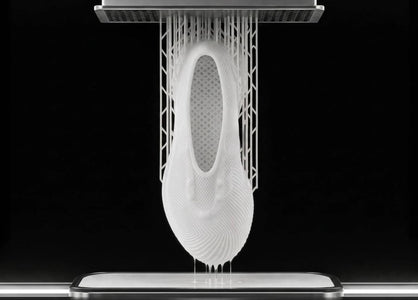
Nexbie takes this idea further with a DLP-based process called HALS, or Hindered Asynchronous Light Synthesis. The main difference is that the printing process is more continuous. Instead of constantly stopping to cure and separate one layer before moving to the next, HALS keeps resin flowing beneath the part while it is being formed. This allows the structure to build more smoothly and avoids the obvious layered look often associated with 3D printing.
That matters more in footwear than it might sound. An ordinary shoe consists of many individual components, including the upper, the midsole, the outsole, etc. These are normally all sewn or glued together. Nexbie can produce much of a 3D printed shoe from one continuous piece. It means fewer joints and a lower chance of cracks and separations of components after going through several bending cycles.
The method allows more control over the structure of the lattice inside the shoe. The lattice does not need to be equally rigid/soft in every part of the shoe. Different areas can be adjusted depending on whether they need more flexibility, cushioning, or support. The same open lattice also helps with airflow and drainage, so those features come from the structure itself rather than from adding extra mesh panels or ventilation holes later.
This is how shoes like Aeroraise and Aeriscape got their one-piece construction and flexibility.
Pros
-
Quick curing of the material
-
Great precision and surface quality
-
Versatile for small and complex parts
Cons
-
Still requires resin handling and finishing
-
Build size can be limited
-
The cost of materials might be higher than the basic FDM filament
SLS (Selective Laser Sintering)
SLS uses a bed of powdered material rather than filament or liquid resin. A laser selectively heats areas of the powder, causing particles to fuse together and form one layer. Fresh powder is then spread across the build area, and the process repeats. A good advantage of SLS is that parts are surrounded by loose powder, which also supports the parts, so conventional support structures are generally unnecessary.
Pros
-
Can produce complex geometries
-
Does not require conventional support structures
-
Strong, functional polymer parts are possible
-
Suitable for mass production of smaller pieces
Cons
-
Machines and materials are more expensive than basic FDM
-
Parts can have a somewhat grainy surface
SLM (Selective Laser Melting)
SLM is a metal powder-bed process. A layer of metal powder is spread across the build platform, and a high-powered laser melts selected areas according to the digital design. Once the layer solidifies, another layer of powder is added. Unlike sintering processes, SLM fully melts the selected metal powder, which allows the production of dense metal parts with useful mechanical properties.
Pros
-
Produces sturdy, thick metal parts
-
Enables complex internal geometries
-
Less production waste in comparison to subtractive manufacturing
Cons
-
Equipment is costly
-
Components need support systems and post-processing
-
More demanding in terms of control than polymer printing
PolyJet
PolyJet functions as an inkjet printer rather than a standard extrusion printer. Small amounts of liquid photopolymer are sprayed on the platform and cured with ultraviolet light. The printer can use different materials during the same build, which is one of PolyJet's biggest advantages.

Pros
-
Finest details and smooth surfaces
-
Multiple materials can be combined in one print
-
Has realistic colors and textures
-
Great for production visual and tactile prototypes
Cons
-
Materials can be expensive
-
Photopolymer parts may have limited long-term durability
-
Support material has to be removed
DMLS (Direct Metal Laser Sintering)
DMLS also works with a bed of metal powder but uses a laser to selectively sinter metal alloy powder layer by layer. The term is often used interchangeably with SLM because of a similar powder-bed concept. The distinction is mainly related to how the metal powder is fused and the terminology used by different manufacturers and industries.
Pros
-
Can make complex metal parts and hardware
-
Allows lightweight structures that cannot be produced through traditional machining
-
Suitable for customized components and small-batch production
-
Works with a range of metal alloys
Cons
-
High prices of equipment and process
-
Parts usually need finishing after printing
-
Process parameters must be tightly controlled
EBM (Electron Beam Melting)
EBM belongs to the powder-bed fusion family too, but swaps the laser for a high-energy electron beam. The metal powder is spread into a layer inside a vacuum chamber, and the electron beam selectively melts the material to create the part. The heated powder bed and vacuum environment make EBM particularly suited to certain metal alloys and demanding applications.
Pros
-
Produces strong metal parts
-
Can work with reactive metal materials such as titanium
-
Lower residual stress can be an advantage in some builds
-
Useful for complex internal structures
Cons
-
Requires a vacuum chamber
-
Equipment is expensive
-
Surface finish can require additional processing
-
Material and machine choices are more specialized
FAQs
Q: What are major types of 3d printing?
A: The major processes include FDM, SLA, DLP, SLS, SLM, PolyJet, DMLS, and EBM. They differ mainly in how they deposit, cure, sinter, or melt material.
Q: What is the difference between FDM and SLS?
A: FDM melts filament through a heated nozzle, while SLS uses a laser to fuse powdered material. FDM is generally simpler and more affordable, while SLS handles complex shapes without conventional support structures.
Q: What are SLA, SLS, and FDM?
A: SLA cures liquid resin with light, SLS fuses powdered material with a laser, and FDM extrudes melted thermoplastic filament. They also differ considerably in surface finish, materials, equipment cost, and typical applications.
Q: What is a DLP 3D printer?
A: A DLP printer uses projected light to cure an entire resin layer at once. This differs from laser SLA, which traces the layer point by point, and can make DLP useful for detailed parts and faster resin production.
Conclusion
Various types of 3D printing are available since there is no one method that can deal with all kinds of materials, geometries, and production needs. For example, FDM is best for low-cost plastic parts. SLA and DLP work better for intricate resin shapes. SLS makes it possible to come up with complicated polymer parts, while SLM, DMLS, and EBM help to create metal parts using powder bed printing. The PolyJet technology provides a solution for detailed models made of different materials. Knowing them helps you understand which process matches the material, part requirements, production volume, and level of detail you actually need.